


Well, combination of prediction demand, operational automation and improved decision-making capability from a single system would benefit your business operations. The market for ERP solutions is experiencing rapid growth because businesses that need to implement these systems will generate revenues of more than $101 billion by 2026. Actual expense of ERP software development needs to be evaluated at this point.
Entire ERP software development cost will vary according to the system requirements and the system needs of the user who must choose between custom-built systems and standard systems. The implementation of artificial intelligence through modern ERP systems enables businesses to enhance their operations while decreasing their expenses.
The typical development costs for ERP software in 2026 start at $40,000 for small businesses and reach beyond $400,000 for enterprise-level solutions, while AI systems require 30-50% higher investment.
ERP Software Cost Breakdown
The initial overview presents high-level cost information related to different business sizes and their operational complexity.
| Business Size | ERP Type | Estimated Cost Range | Timeline |
| Small Business | Basic Custom ERP | $3,000 – $25,000 | 3–6 months |
| Mid-Market | Mid-Complexity ERP | $20,000 – $125,000 | 6–12 months |
| Large Enterprise / MNC | Full-Scale ERP | $250,000 – $400,000+ | 12–18 months |
How Much Does it Cost to Develop an ERP Software?
Custom ERP development cost follows a very simple formula: Cost = (Total Development Hours) x (Hourly Rate) + Infrastructure + Integrations + Post-Launch Support.
For example, the base cost of ERP software needs 2,000 development hours at a combined rate of $75 per hour totals $150,000, yet this amount excludes integration costs and training expenses.
Here is how development effort is typically distributed across a standard ERP project:
6 Factors Influencing ERP Pricing Structure
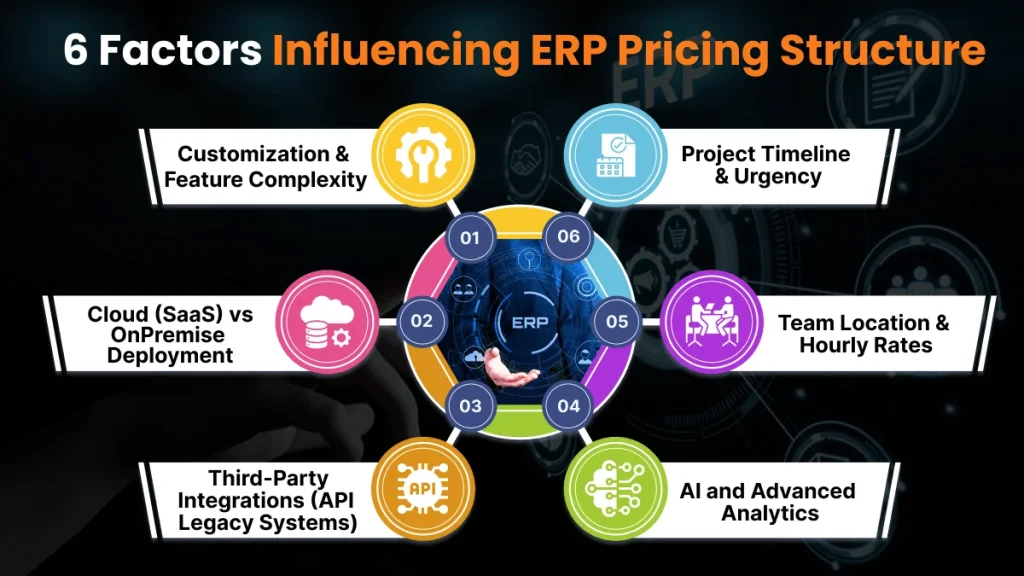
Here are the seven variables that are the core determinants of your total investment for the project. Let’s start with the first one:
1. Customization & Feature Complexity
This is consistently the largest single cost driver. Your business needs custom ERP solutions because it provides fundamental structure yet creates extra expenses for your organization. The development process needs additional time for every custom approval system, regulatory compliance element, and industry-specific component that needs implementation.
- Standard customization: $10k – $50k+
- Moderate customization: $50k – $200k+
- Deep customization: $200k – $500k+
2. Cloud (SaaS) vs. On-Premise Deployment
Your deployment choice changes your entire cost structure, not just the upfront number.
| Factor | Cloud / SaaS ERP | On-Premise ERP |
| Upfront Cost | Low | High |
| Infrastructure | Vendor-managed | Customer-managed |
| Maintenance | Automatic | Manual |
| Scalability | Instant, elastic | Slow/Costly |
| 5-Year TCO (100 users) | Lower | Higher |
| Best For | SMEs, fast-growing businesses | Regulated industries, data sovereignty |
Cloud-first adoption is accelerating in 2026. Cloud ERP eliminates hardware and infrastructure expenses, which organizations must pay upfront, while requiring organizations to make ongoing subscription payments for SaaS products. The five-year total cost of ownership for cloud ERP systems is more affordable for most SMBs with fewer than 200 users.
3. Third-Party Integrations (API, Legacy Systems)
Modern ERPs require connection with other systems to function effectively. The second most common cause of ERP project budget overruns occurs because of difficulties with system integration. Every integration process needs API creation plus data mapping, error management, and system upkeep.
- Simple REST API (payment gateway, CRM): $2,000–$15,000 per integration
- Legacy system migration (SAP/Oracle to custom ERP): $30,000–$150,000+
- IoT device integration (manufacturing, logistics): $15,000–$50,000+
- E-commerce platform sync (Shopify, Magento): $25,000 and $150,000+
4. AI and Advanced Analytics
The total costs of your 2026 ERP deployment will depend on the Artificial Intelligence system you choose for your organization. AI-native ERP systems, built with machine learning from the ground up, cost 30–50% more than standard builds.
The system delivers higher business value through three functions, including predictive demand forecasting, intelligent procurement automation, and AI-assisted reporting. The costs of an AI/ML analytics module range from $15,000 to $50,000 based on how complex the data is and how advanced the models are.
5. Team Location & Hourly Rates
The location of developers provides organizations with their best opportunity to have affordable ERP development expenses while maintaining development standards. North American teams face development expenses that are 40-60% higher than development costs for developers based in India or Southeast Asia.
| Location/Region | Relative Cost (%) | Cost Tier | Representative Hourly Rates (2026) |
| United States | 100% (Baseline) | High | $100 – $200+ |
| Canada/W. Europe | 60% – 90% | High-Med | $70 – $150+ |
| Eastern Europe | 30% – 50% | Medium | $35 – $70 (Ukraine/Poland) |
| Latin America | 30% – 60% | Medium | $35 – $75 (Brazil/Mexico) |
| India | 15% – 40% | Low | $15 – $55 (Wide range) |
| SE Asia/Phil. | 15% – 35% | Low | $15 – $50 (Vietnam/Phil.) |
6. Project Timeline & Urgency
Rushed timelines inflate costs in two ways because they need more workers to build products and create higher chances of expensive software defects appearing after product release. Your project expenses increase by 8 to 15 percent for every month you extend your project schedule. Building buffer time during discovery is the single most cost-efficient planning decision you can make.
ERP Software Pricing Plans of the Top 10 ERP Systems
ERP software pricing plans vary widely across leading platforms and charge different fees based on deployment type, available features, and system expansion capabilities. Therefore, organizations must conduct a thorough analysis of costs, user requirements, and their actual system deployment needs.
| ERP Software | Deployment | Cost Per User | Price Range (TCO) | Best For | Min. Implementation Fee | Total Installs | User Range |
| NetSuite ERP | Cloud | $125/mo | $10K – $100K | Mid-sized, fast-growing companies | $10K | 37,000+ | 10— unlimited |
| Sage X3 ERP | Cloud / On-Prem | $75/mo | $25K – $250K | Manufacturing, distribution | $10K | 7000 | 10 — 1000 |
| Epicor Kinetic | Cloud / On-Prem | $125/mo | $4K – $500K | Manufacturing, supply chain | $50K+ | 4500+ | 10—Unlimited |
| DELMIAWorks | Cloud / On-Prem | $250/mo | $25K – $300K | Manufacturing SMEs | $20K | 1200+ | 5—Unlimited |
| Cetec ERP | Cloud / On-Prem | $50/mo | $3K – $40,000K | Small manufacturers | $0 | 250+ | 5—Unlimited |
| SAP S/4HANA | Cloud | $200/mo | N/A | Large enterprises | $75K | 10,000+ | 15—Unlimited |
| Acumatica Cloud ERP | Cloud / On-Prem | N/A | $7.50K – $150K | SMBs, service businesses | $10k | 1000+ | 5—Unlimited |
| Infor CloudSuite | Cloud / On-Prem | $150/mo | $25K – $500K | Manufacturing, logistics enterprises | $25K | 2500+ | 5— 1000 |
| Microsoft Dynamics 365 | Cloud | $175/mo | N/A | Enterprises, Microsoft ecosystem | $35K | 2000+ | 10—Unlimited |
| QAD Adaptive ERP | Cloud / On-Prem | $250/mo | $25K – $300K | Manufacturing, automotive | $20K | 1200+ | 5—Unlimited |
What is ERP Software and Why It Matters for Businesses
The Enterprise Resource Planning (ERP) system functions as a complete software solution that links and streamlines fundamental business operations that include financial management, human resources, supply chain activities, manufacturing processes, and customer relationship handling into one centralized information system that all organization members can access.
The investment case for ERP in 2026 is stronger than ever. Organizations achieve complete recovery of their ERP implementation cost between 12-36 months. ROI is driven by:
1. Labor Cost Reduction
The process automation delivers 15–30% savings in manual task time.
2. Faster Decision-Making
The real-time data replaces weekly reports and departmental silos.
3. Reduced Error Rates
The automated workflows eliminate manual input mistakes in invoicing, inventory and payroll.
4. Regulatory Compliance
The automated audit trails for GDPR, HIPAA, and SOC2 reduce compliance overhead by 40%.
5. Customer Satisfaction
The streamlined order management reduces fulfilment time and errors.
The Finance and Operations departments experience initial ROI benefits extending to HR and Procurement because these functions involve high-volume manual work that incurs high operational costs.
5+ Types of ERP Software Pricing Models
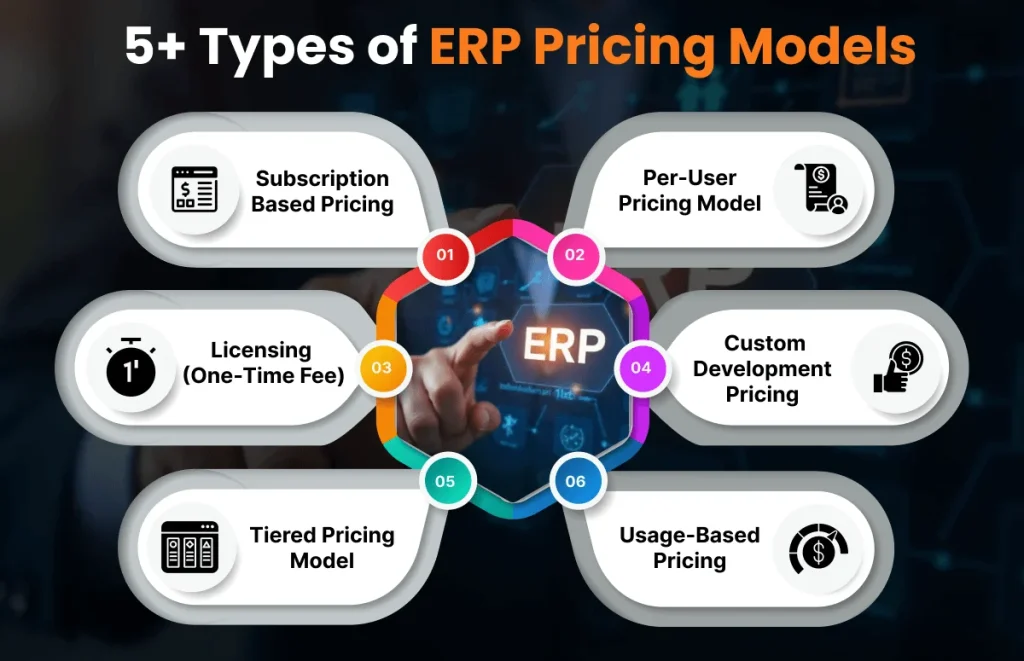
Companies can forecast their ERP software development cost and maintain their financial limits while selecting the most affordable implementation method through their comprehension of ERP software pricing models.
1. Subscription-Based Pricing
The subscription model enables businesses to establish predictable ERP software expenses through monthly or annual payments while reducing initial enterprise resource planning costs for new companies and small businesses. Platforms such as Flexprice can also help businesses manage and streamline subscription-based billing as they scale.
- How It Works: Monthly/annual fee per user
- Best For: Cloud ERP, SMBs
- Risk Level: Low upfront, high long-term
2. Per-User Pricing Model
Charges depend on user count, resulting in increased ERP software costs for small businesses when their teams grow and need additional system access.
- How It Works: Charges per active user.
- Best For: Growing businesses
- Risk Level: Medium, scales with needs
3. Licensing (One-Time Fee)
The one-time licensing model requires businesses to pay greater initial costs for ERP software, which leads to lower total ERP software costs compared to subscription-based payment methods.
- How It Works: One-time fee + annual maintenance
- Best For: On-premise, large enterprises
- Risk Level: Medium, high initial investment
4. Custom Development Pricing
The cost of custom ERP development services varies according to system features and integration needs, and project complexity provides operational flexibility but significantly raises total ERP implementation cost.
- How It Works: Pay based on project scope
- Best For: Complex business needs
- Risk Level: High, scope-dependent
5. Tiered Pricing Model
ERP software tiered pricing systems provide businesses with multiple package options that enable them to match their enterprise resource planning requirements with specific features.
- How It Works: Different pricing tiers
- Best For: Mid-sized businesses.
- Risk Level: Medium, feature limitations
6. Usage-Based Pricing
The system operates with two primary costs stemming from user activity measured through their transactions and storage needs, which determine both ERP maintenance cost per year and total ERP system implementation expenses.
- How It Works: Pay per usage metrics
- Best For: Variable usage businesses
- Risk Level: Medium to high variability
Note: Octal IT Solution recommends a fixed-price model for their specific ERP development work that has clear project requirements, while using a time and materials contract for projects that will be developed through agile discovery sprints.
Comparing Costs of Different ERP Deployment Models
Your deployment model is often the single most impactful budget decision in an ERP project. The three primary options carry distinct cost profiles across the project lifecycle
1. Cloud ERP
The Cloud ERP system requires lower initial expenses, and it needs 3-6 months for installation, while its users must pay subscription fees between $70 to $150 per month for each user. The solution functions as the most suitable option for organizations that need to achieve fast growth while maintaining their ability to expand operations.
2. On-Premise ERP
Higher upfront investment ($10,000–$15,000/user licensing), full control over data and infrastructure. Best for regulated industries with strict data residency requirements (banking, defense, healthcare).
3. Hybrid ERP
Core operations on-premise, customer-facing modules in the cloud. The market experiences rapid growth during 2026, which especially benefits mid-sized manufacturers that want to achieve compliance while maintaining operational flexibility. The system costs 15 to 25% more than cloud-only solutions, yet it remains cheaper than complete on-premises systems operating throughout their entire duration.

Custom ERP Development Cost by Industry
Industry-specific compliance requirements are the single biggest cost multiplier in custom ERP development. Businesses in regulated sectors should add 20–40% to standard estimates to account for compliance architecture.
| Industry | Cost Range | Key Cost Drivers |
| Manufacturing | $30k-$60k+ | Production planning, MES integration, IoT devices |
| Healthcare (HIPAA-compliant) | $100K-$250K+ | Patient data security, HL7/FHIR integration, compliance |
| Retail & E-commerce | $75K to $200K+ | Inventory sync, POS integration, multi-channel management |
| Logistics & Supply Chain | $60K – $150K | Route optimization, carrier APIs, real-time tracking |
| Education | $30K–$80K+ | Student management, LMS integration, fee management |
| Financial Services | $100K – $300K+ | Regulatory compliance, audit trails, multi-currency |
How to Estimate ERP Development Cost (Step-by-Step Guide)
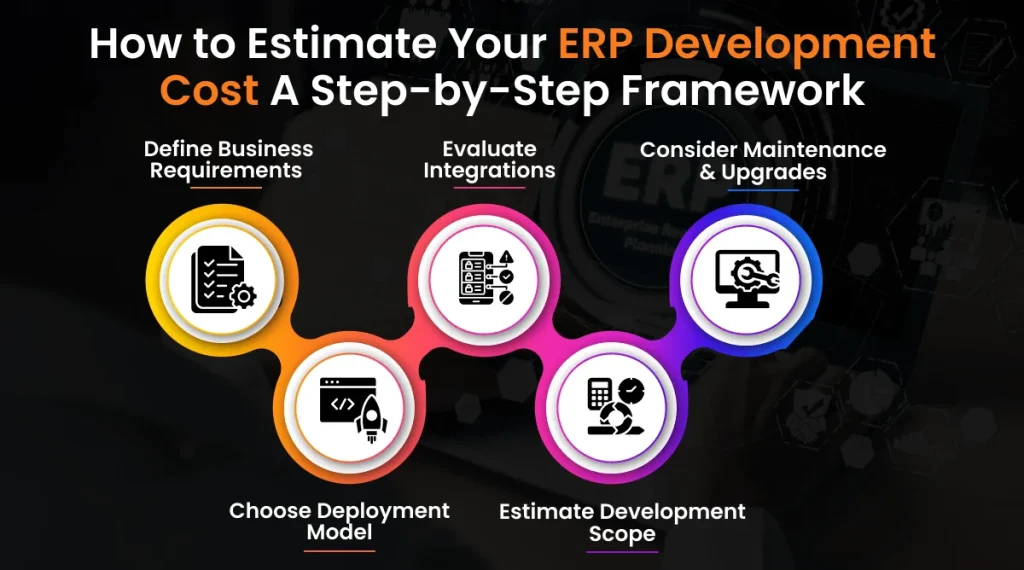
The ERP software development cost estimation process requires an organized approach that evaluates system elements together with integration components to calculate total enterprise resource planning expenses.
1. Define Business Requirements
Actual ERP software development costs must be determined through the identification of essential system components and core system functions, which will prevent unnecessary expenses for customized ERP development.
2. Choose Deployment Model
The organization needs to select between cloud and on-premise solutions because the selected deployment method will determine both enterprise resource planning cost and ERP software expenses.
3. Evaluate Integrations
The companies are required to evaluate all necessary third-party integrations because their complexity impacts both ERP system implementation costs and total expenses for ERP implementation.
4. Estimate Development Scope
System complexity, together with user roles and scalability information, needs to be defined because it will enable accurate cost estimations of custom ERP development and ongoing ERP software costs.
5. Consider Maintenance & Upgrades
All ongoing updates together with support services need to be included because they create ERP maintenance cost per year and total development cost.
ERP Cost Myths Debunked: What the Internet Gets Wrong
Most online advice about ERP pricing is misleading and generates confusion for businesses that attempt to calculate their actual development and implementation expenses.
Myth 1: ERP is only for large enterprises
Reality: In 2026, more than 60% of ERP systems will function specifically to support small and medium-sized businesses. The starting price for ERP systems using cloud and modular solutions begins at $40000.
Myth 2: Lower hourly rates mean lower cost
Reality: The development process requires more resources when developers work on inexpensive products, resulting in higher costs. Total costs should be examined instead of using hourly rates as the only basis for assessment.
Myth 3: Off-the-shelf ERP is always cheaper
Reality: The total costs for using an off-the-shelf ERP system will exceed those of a custom ERP solution because of licensing costs, upgrade expenses, and vendor lock-in.
Myth 4: AI makes ERP cheaper
Reality: AI systems decrease the amount of coding work needed to develop software, yet their advanced functions, which include automation and predictive analytics, lead to 30-50% expense increases.
Hidden Costs of ERP Implementation You Must Know
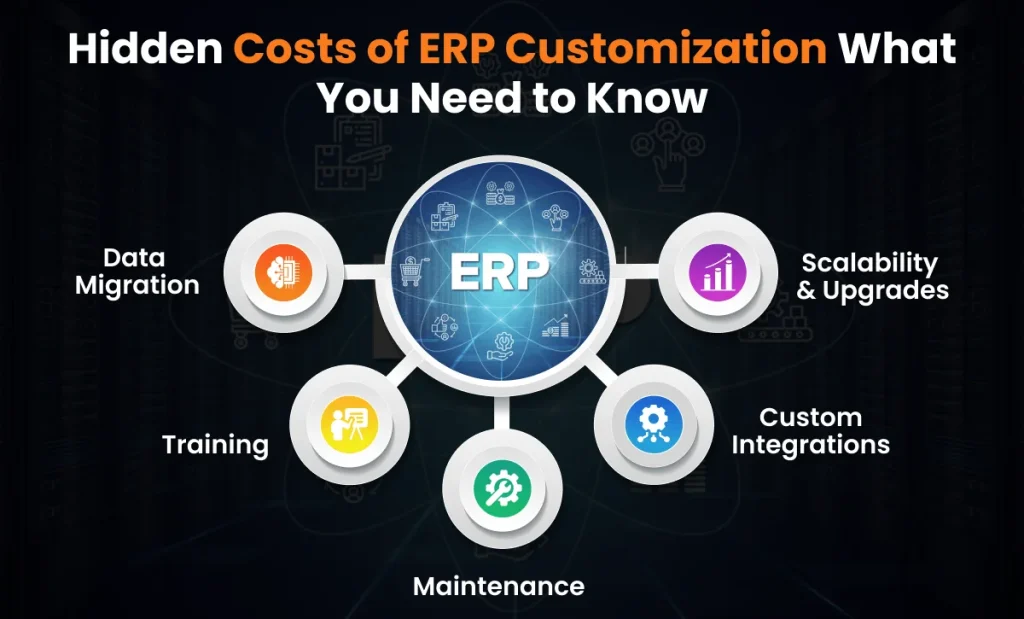
The hidden expenses that arise when companies customize their ERP systems exceed their initial budget estimates, and this expense increase leads to higher costs for ERP software development and continual enterprise resource planning operations.
1. Data Migration
The process of migrating data from existing systems to a new ERP system requires three essential steps, including data cleansing, data validation, and data mapping.
2. Training
Employee training is necessary for successful system implementation and this training process increases ERP implementation cost while it helps teams learn to operate new system capabilities and procedures.
3. Maintenance
The ERP maintenance cost per year includes updates, bug fixes, system upgrades and these expenses continue to accumulate throughout the system’s operational lifespan after the initial development.
4. Custom Integrations
The process of connecting ERP systems with current business applications or external software solutions leads to increased custom development costs when organizations need to integrate their systems with existing business applications and older software systems.
5. Scalability & Upgrades
The process of future system expansion, new feature development, and system upgrades makes the pricing models of ERP software development more difficult to understand and leads to increased enterprise resource planning cost over time.
How AI Is Reshaping ERP Development Costs in 2026
The current development of ERP systems experiences its most significant change through AI, creating additional expense categories while generating new ROI opportunities.
AI-Native vs. AI-Bolted-On ERP
AI-native ERPs start their system design from their initial development stage by using data pipelines and model training. AI-bolted-on ERPs spend more on integration scaffolding than on actual intelligence, delivering lower capability at higher ongoing maintenance cost.
New Cost Centers Introduced by AI in 2026
- Enterprise-grade implementation of LLM API integration requires a budget between $10,000 and $30,000.
- The cost of AI model training using proprietary business data ranges from $15,000 to $50,000.
- The development of Copilot-style user interfaces requires a budget between $20,000 and $40,000.
- The annual costs for maintaining and retraining AI models range from $8,000 to $20,000.
Where AI Reduces ERP Development Costs
AI code generation tools enable developers to finish backend development projects at a faster rate, ranging between 15-25%. Automated testing frameworks reduce QA costs by 20–30%. The AI-augmented development workflow at Octal IT Solution enables companies to transfer these savings directly to the client budgets, thereby making enterprise-quality ERP accessible to all budget ranges.
How Can Octal IT Solution Help You with ERP Software Development?
The Octal IT Solution team provides budget-friendly ERP Software Development Services through their phased development process, which uses essential system minimums as its foundation. Our process begins with the core ERP MVP, which includes Finance, HR, and Inventory modules to help us decrease initial ERP software development costs while achieving faster ROI.
Our ERP Cost Optimization Strategies:
- At Octal IT Solution, we create a budget-friendly MVP solution that helps in cutting ERP software cost for small businesses while we test their actual business requirements.
- The business uses its actual system usage data to develop new modules and enables companies to save money by avoiding unnecessary custom ERP development expenses while they maximize their existing resources.
- The company introduces its sophisticated AI capabilities to manage enterprise resource planning cost while achieving the highest return on investment without incurring high initial costs.
This strategy enables organizations to achieve quicker system implementation while maintaining effective financial management and reducing total expenses throughout the entire ERP system deployment process.
Final Words
The ERP software development cost in 2026 starts at $40,000 for basic systems and extends to multiple millions of dollars for AI-powered enterprise solutions. The total cost of ownership over the five-year period functions as the main determinant instead of the initial price needs assessment.
Successful businesses define a clear scope, plan for hidden costs, and adopt phased development. The selection of an appropriate ERP Software Development Company becomes essential for organizations to achieve maximum return on investment and sustained value.
Octal IT Solution provides reliable software development consulting services, and the developers combine expertise and innovation to deliver cost-effective ERP solutions for long-term success.


 Get in Touch
 By
By September 30, 2026