


Key Takeaways
- Proof of Concept in software development validates feasibility before full build, answering what is proof of concept in software development with quick, low-risk testing.
- Problem definition, scope, success metrics, tech stack, and prototype covering Key Components of a Proof of Concept and technology proof of concept.
- Some use cases: PoC in software development → prototype → MVP; e.g., a fintech web application development PoC testing payment APIs.
- It reduces software development cost, aligns with trends like custom software POC development and rapid MVP development services.
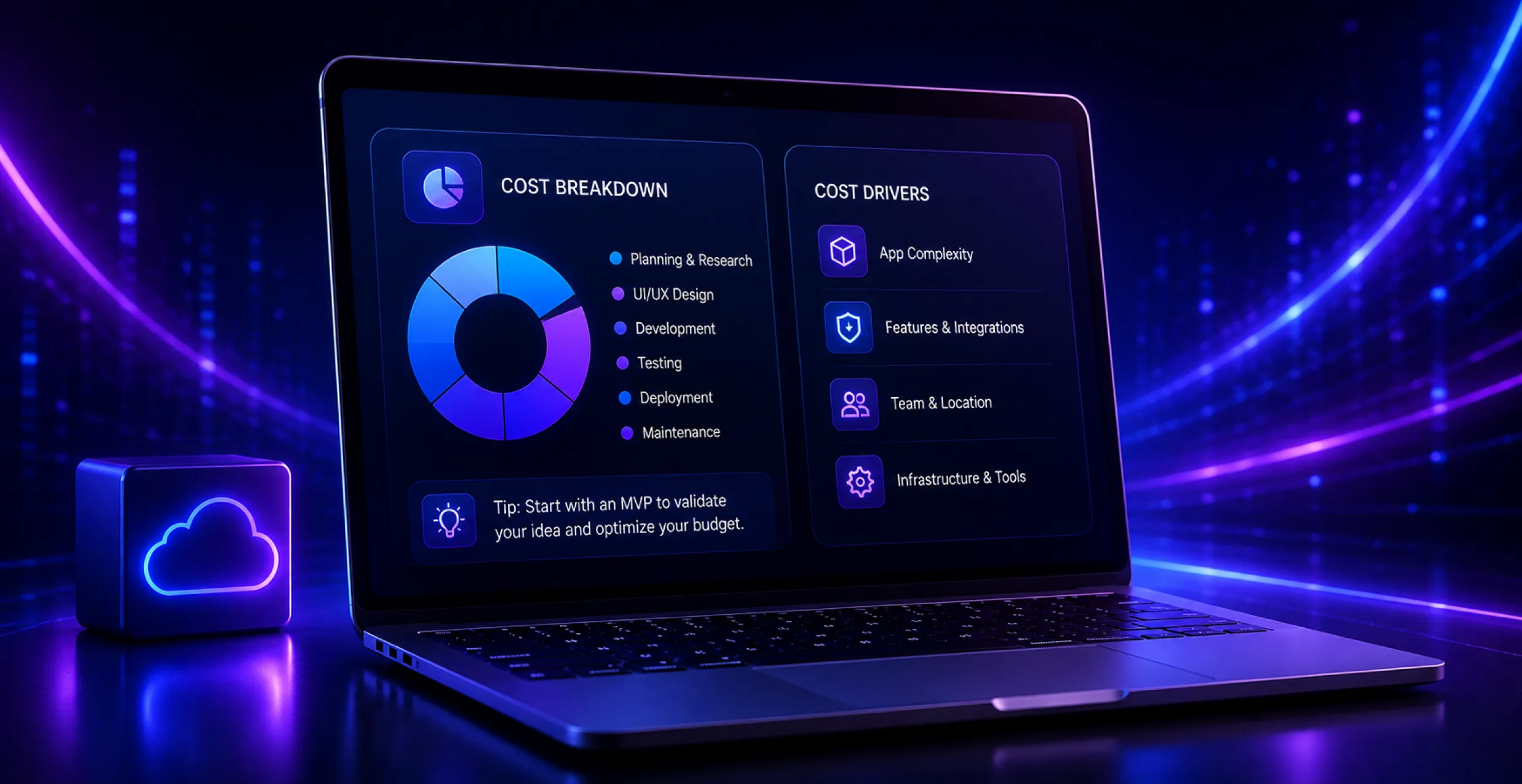
- Software POC development cost varies by scope, team, and enterprise software development needs.
Introduction
The contemporary imminent digital world cannot allow companies to invest blindly in new ideas without confirming their viability. The Proof of Concept in software development comes here as it is very handy.
It enables organizations to determine the viability of a concept and whether it can be converted into a viable product before the organization is obligated to spend a lot of time and resources.
An effective Proof of Concept software development strategy would be used to establish the technical issues, test assumptions, and keep in step with business objectives. PoC serves as a basis of effective decision-making, whether it is an enterprise investigating innovation or a startup trying to develop proof of concept to succeed as a startup.
Even companies that provide custom software development services tend to suggest PoC as an initial stage of the development process. The use of a formal software development proof of concept enables businesses to minimize the risk, enhance productivity, and develop products faster with high confidence.
This guide will navigate you through the reasons, benefits, cost of implementing PoC, hiring developers for this purpose, future trends and common mistakes that should be prevented going forward.
What is Proof of Concept in Software Development?
Proof of concept is a process that is applied to determine the viability of a particular idea, feature, or technology in practical circumstances. A Proof of Concept in software development can be described as a small implementation that is not a full product that is created to check the functionality and feasibility.
A PoC is generally a 2-4 week effort to validate assumptions, i.e. an MVP, rather than a polished product.
- Can the idea be technically implemented?
- Will it solve the intended problem?
- Are there any hidden risks?
- Does the technology work as expected?
- Can this complex algorithm, integration, or feature actually work in the real world?
- Will the application meet required performance standards (e.g., speed, load handling) under realistic conditions?
- Will new software interact successfully with existing systems and third-party APIs?
- Does this concept truly solve the user’s problem and offer a valuable solution?
- What technical limitations could cause this project to fail or require costly corrections later?
- Are the estimated time, cost, and expertise requirements reasonable?
Innovative ideas are frequently proven by the development of the proof of concept, which is used by businesses to justify their focus on such new technologies as AI, blockchain, or IoT. An effective PoC makes sure that the groundwork is solid when embarking to embark into full development or proceeding into MVP development services.
Why PoC Matters in Modern Software Development?
A software development structured PoC ensures that before full scale production is invested in, technical feasibility has been tested. It aids in determining the possible bottlenecks, integration, and scaling problems.
PoC is an effective strategy to attract investors by showing the viability of a startup, especially in startups that are trying to develop proof of concept to arrive at the initial startup. Technology proof of concept is used by the enterprise to test new tools without having to interrupt existing systems.
Also, Proof of Concept software development helps in the enhanced stakeholder, developer, and business team collaboration. The organizations can make wiser and data-driven decisions with the proper approach and the services provided by IT consultants and this results to successful product launching.
What are Key Components of a Proof of Concept?
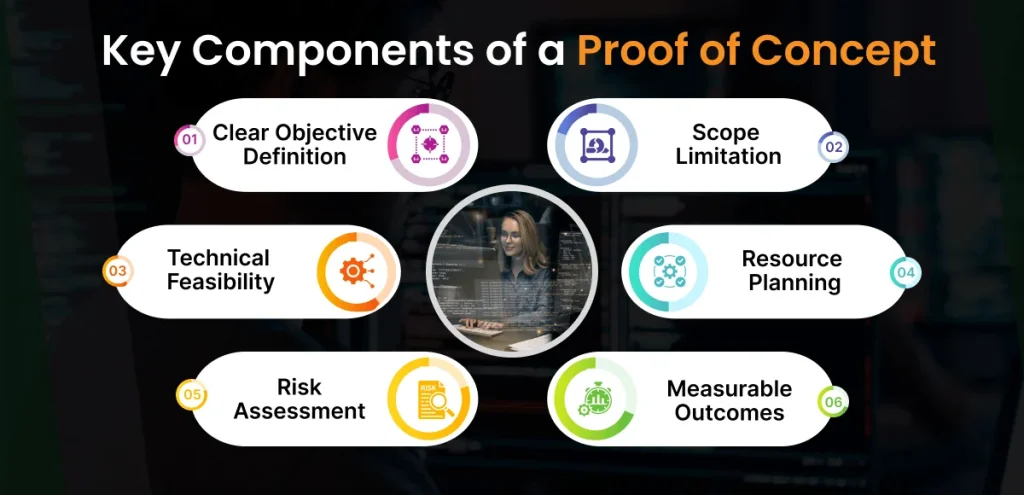
An effective Proof of Concept in software development must be planned and executed well. Knowledge of the Key Components of a Proof of Concept is necessary to make sure that your PoC can provide valuable insights and make business goals.
1. Clear Objective Definition
Every software development proof of concept should have a well clarified objective. This involves the definition of the problem to be solved, anticipated results and the terms of success. In the absence of clarity, the PoC can be lost and unable to provide concrete outcomes.
2. Scope Limitation
A PoC is supposed to be targeted at a given feature or functionality that occurred as opposed to the overall system. The scope will guarantee quick implementation and enable team to focus on the validation of the core idea successfully in the process of development of a proof of concept.
3. Technical Feasibility
One of the fundamental components of any Proof of Concept software development methodology is testing of technical feasibility. It includes an assessment of tools, structures and integrations, to ascertain whether the concept can be implemented in a reality setting or not.
4. Resource Planning
A successful PoC requires appropriate reallocation of time, budget, and talent. Companies intending to custom software POC development should be able to assure talented developers and appropriate tools to implement the concept effectively.
5. Risk Assessment
Early detection of the risks is very important in PoC in software development. This consists of technical risks, operational issues and scalability issues. These problems can be detected at the PoC stage and avoided at the later stages that can be costly.
6. Measurable Outcomes
A PoC should provide quantifiable outcomes to know whether it was successful or not. Prof metrics like performance, usability and integration success in Proof of Concept in software development can be used to assess the idea whether it should be pursued further or not.

Proof of Concept vs Prototype vs MVP
Having proper understanding of Proof of Concept vs Prototype vs MVP is critical towards the selection of appropriate development strategy. All the three are idea validators, but have varying roles in the product development lifecycle.
| Aspect | Proof of Concept in software development | Prototype | MVP |
| Purpose | Validate feasibility | Visualize design | Launch usable product |
| Focus | Functionality testing | UI/UX | Core features |
| Development Stage | Initial | Mid-stage | Pre-launch |
| Users | Internal stakeholders | Limited users | Real users |
| Cost | Low | Medium | Higher |
| Outcome | Feasibility validation | Design feedback | Market validation |
What is the Step-by-Step Process to Build a PoC?
Structured Proof of Concept in software development makes sure that your concept is proved to be feasible with efficiency. Having a defined procedure would reduce the risks and maximize the results in Proof of Concept software development.
Step 1: Define the Problem Statement
In any software development process, the initial step would be to determine the precise problem that you wish to solve. Defined problem statement is the guarantee that the business objectives and technical implementation are in line and the software development proof of concept is result-driven and more focused.
Step 2: Identify Success Criteria
Create objectives that can be measured to gauge the success of the PoC. Performance benchmarks, usability or integration capabilities may be success metrics in PoC in the context of software development. This is a necessary measure that will guarantee that your proof of concept development provides actionable insights.
Step 3: Choose the Right Technology
The choice of appropriate tools and structures is important during technology proof of concept. Technology stack must match the requirements of scalability, performance, and future development objectives. It is particularly in the case of custom software POC development.
Step 4: Develop the PoC
At this point, the developers construct a bare-bones of the solution to test the idea. Proof of Concept software development is concerned with basic functionality alone, and guarantees fast testing and feedback without redundant complexity.
Step 5: Test and Analyze Results
Every Proof of Concept in software development must have testing. Measuring performance, uncovering bottlenecks, and determining whether the solution was as success as per its predetermined objectives. This stage defines whether it can be scaled out the idea or not.
Step 6: Present Findings and Decide Next Steps
After testing, results are reviewed by the stakeholders. According to the information gained during the proof of concept development, businesses will have the opportunity to continue developing the idea to full extent, pivot it, or even give up when needed.
Octal IT Solution adopts an Agile software development approach while implementing PoC in software development. Our developers provide a solid, validated foundation for developing a Minimum Viable Product (MVP) or full-scale digital platform. We test drive to de-risk projects by verifying core functionality, third-party integrations, and performance under controlled conditions.
What are the Benefits of Proof of Concept Software Development?
The use of Proof of Concept in software development has a lot of benefits to companies that want to innovate the products with minimal risks. It is an important step to prove ideas first and then invest heavily.
1. Risk Reduction
An effective software development proof of concept helps to discover possible technical and operational risks in the initial stage. It assists in eliminating the risk of making costly errors in business and will guarantee safer investment choices in product development.
2. Cost Efficiency
Proof of Concept software development helps to eliminate the unreasonable expenditure on unrealistic projects. It enables companies to make resources efforts and cost optimization in the overall software development cost.
3. Faster Time-to-Market
A streamlined PoC on software development is a process that hastens decision making and minimizes development processes. Upon the feasibility confirmation, the teams can accelerate to full-scale development or web application development.
4. Improved Stakeholder Confidence
A successful PoC in software development proves the viability of an idea, which gains trust with investors, stakeholders, and clients. This is more helpful in attempting to construct evidence of concept of the startup endeavors.
5. Better Resource Utilization
Businesses are able to determine the exact resource needed during the next stage through proof of concept development. This guarantees effective time, budget and manpower allocation.
6. Enhanced Product Quality
The quality of the final product is enhanced because the ideas are tested earlier during Proof of Concept testing in software development. It enables the teams to define the features and remove the problems and then scale to actual development.
Common Mistakes to Avoid in PoC Development
Although Proof of Concept in software development is tremendously useful, there are some errors that may restrict the usefulness. These traps should be avoided to achieve a successful result.
1. Defining a Broad Scope
One of the pitfalls of Proof of Concept software development is attempting to justify too many of the features simultaneously. A narrowed down strategy will guarantee faster outcomes and better insights.
2. Ignoring Business Objectives
A software development proof of concept must be in line with business objectives. The failure to do so will result in technically viable solutions that no longer have real values.
3. Choosing the Wrong Technology
Wrong choice of tools when conducting the technology proof of concept may lead to false conclusions. The technologies should be selected in accordance with long-term objectives.
4. Lack of Clear Metrics
PoC in software development is subjective in the absence of quantifiable measures of success. Specific KPIs should be used to assess the effectiveness of the PoC.
5. Underestimating Time and Resources
Although a PoC is not a complete development, it nevertheless needs proper planning. Ineffective allocation of resources may affect the effectiveness of the put-up of proof of concept.
6. Skipping Testing
In software development, Proof of Concept involves testing. Failure to do this may result in wrong assumptions and faulty decision making.
How to Hire Developers for Proof of Concept?
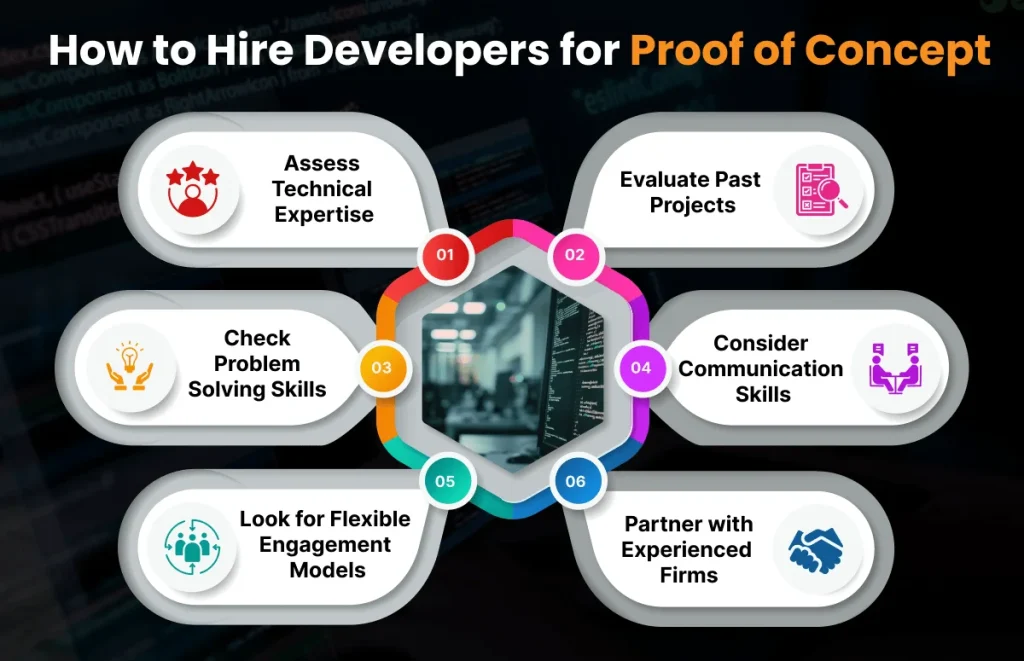
The selection of the appropriate team is a key to the successful Proof of Concept software development. Companies have to take time in making their decisions to achieve quality outcomes.
1. Assess Technical Expertise
Hiring developers to do proof of concept make sure that they are experienced in related technologies. The accuracy in carrying out a software development proof of concept can be done by skilled developers with accuracy.
2. Evaluate Past Projects
Examine past performance in developing proof of concepts to get knowledge of their abilities. It is a good thing to have experience in related industries or technology.
3. Check Problem-Solving Skills
PoC needs to be innovative and critical. Software developers working ought to have the ability to detect the issues and suggest efficient solutions.
4. Consider Communication Skills
Clear and effective communication is as essential as the Proof of Concept itself. Acquaint the developers with critical technical details, at regular intervals, in accordance with Agile principles. I appreciate that you used a new word but I encourage you to make use of active voice.
5. Look for Flexible Engagement Models
The developers who are flexible in hiring models should be selected by the business that plans to develop custom software POC to meet the project requirements and budget.
6. Partner with Experienced Firms
By engaging a stable mobile app development company, it is possible to have the access to professional people and organized processes in the PoC development services.
Hire development team from Octal IT Solution as we are one of the best PoC software development partners in the market that have handled various tech projects.
Software PoC Development Cost Breakdown
Knowledge in software POC development cost assists in budget planning by businesses. The average cost of Proof of Concept in software development is as shown below:
| Cost Component | Description | Estimated Cost Range |
| Requirement Analysis | Defining objectives and scope | $1,000 – $3,000 |
| Design & Architecture | Creating system design | $2,000 – $5,000 |
| Development | Core PoC implementation | $5,000 – $15,000 |
| Testing & Validation | Performance and usability testing | $2,000 – $6,000 |
| Tools & Technologies | Licenses, APIs, frameworks | $1,000 – $4,000 |
| Total Estimated Cost | Complete PoC development | $10,000 – $30,000 |
Best Practices for Successful PoC Development
The businesses have to undergo the time-tested strategies to ensure that Proof of Concept on software development is as effective as possible. Such best practices make sure that the Proof of Concept software development that you have achieved is accurate and provides actionable results.
1. Keep It Simple and Focused
An effective software development proof of concept is one that solely deals with core functionality verification. It is necessary to avoid introducing more features that may complicate the process and lengthen the results.
2. Define Clear Objectives
It is obvious that clear objectives are crucial in PoC in software development. Having an idea of what you would like to accomplish will aid in shaping the development process and will guarantee any significant results.
3. Use the Right Tools and Technologies
The choice of tools is important to proper technology proof of concept. Make sure that the selected technology stack satisfies both long-term scalability and performance needs.
4. Involve Stakeholders Early
Involving stakeholders in the development of proof of concept provides coordination between the technical implementation and the business requirements. Their responses are useful in streamlining the PoC.
5. Document Everything
Paperwork is neglected in Proof of Concept in software development. Recording the decisions, challenges and the results, assists in shaping the further development stages.
6. Collaborate with Experts
The collaboration with the providers with more experience in developing PoC makes the approach organized. Professionals are able to lead businesses through the mazes and provide credible outcomes.
Future Trends in Proof of Concept in Software Development
With the advancement of technology, Proof of Concept in software development is becoming more superior and tactical. Businesses are capitalizing on the emerging developments to increase their Proof of Concept software development processes.
1. AI-Driven PoC Development
Proof of concept is changing technology in artificial intelligence wherein testing, analyzing and decision making processes are automatized and, therefore, are faster and more precise.
2. Cloud-Based PoC Solutions
Cloud computing platforms make it possible to develop proof of concepts both in a scalable and cost-efficient manner, because they do not demand huge infrastructure investments to prove their idea.
3. Low-Code and No-Code Platforms
PoC is becoming easy in software building with low-code tools, which are helping build prototypes and minimize reliance on large-scale code.
4. Increased Focus on Cybersecurity
Security is emerging as a burning feature of Proof of Concept in software development particularly when sensitive data and enterprise applications are involved.
5. Integration with Agile and DevOps
The current development of Proof of Concept Software uses a close integration with Agile and DevOps practices, which promote the constant testing and accelerated iterations.
6. Rise of Industry-Specific PoCs
Companies are shifting more towards the use of custom software POC development solutions to address the industry specific needs and issues.
Proof of Concept in Software Development Example
The knowledge of real life applications makes it clearer why Proof of Concept is useful in software development. Some Proof of concept examples are practical and are below:
| Industry | Use Case | PoC Objective | Outcome |
| Healthcare | AI Diagnosis Tool | Validate accuracy of predictions | Improved diagnostic efficiency |
| Fintech | Fraud Detection System | Test real-time detection capability | Reduced fraud risks |
| E-commerce | Recommendation Engine | Validate personalization algorithms | Increased conversions |
| Logistics | Route Optimization | Test algorithm efficiency | Reduced delivery time |
| Education | E-learning Platform | Validate scalability | Enhanced user experience |
Why to Avail PoC Development Services at Octal IT Solution?
When it comes to reliable Proof of Concept in software development, Octal IT Solution stands out as a trusted technology partner. With 18+ years of experience in delivering innovative solutions, we specializes in Proof of Concept software development tailored to diverse business needs.
Their team excels in custom software POC development, ensuring that each project is aligned with client objectives and industry standards. Whether you are a startup looking to build proof of concept for startup success or an enterprise exploring innovation, we provide end-to-end PoC development services.
From initial consultation to execution, their experts leverage advanced tools and methodologies to deliver efficient proof of concept development. Additionally, Octal IT Solution offers comprehensive enterprise software development and strategic guidance to help businesses scale successfully.
By choosing Octal IT Solution, companies gain access to experienced professionals who ensure accuracy, efficiency, and faster time-to-market for every PoC initiative.

Conclusion
In an increasingly competitive digital world, Proof of Concept in software development has become a vital step for validating ideas and minimizing risks. It enables businesses to test feasibility, identify challenges, and make informed decisions before committing to full-scale development.
A well-planned Proof of Concept software development approach ensures that both technical and business aspects are aligned from the start. Whether you’re experimenting with new technologies or launching a product, a structured software development proof of concept can significantly improve your chances of success.
From reducing software POC development cost risks to enhancing product quality, PoC plays a critical role in modern development strategies. By leveraging expert PoC development services, businesses can accelerate innovation and stay ahead in the market.
Ultimately, investing in Proof of Concept in software development is not just a technical decision, it’s a strategic move toward building scalable, efficient, and successful digital solutions.
Feel free to reach our team and become a part of this digital transformation!


 Get in Touch
 By
By September 30, 2026