


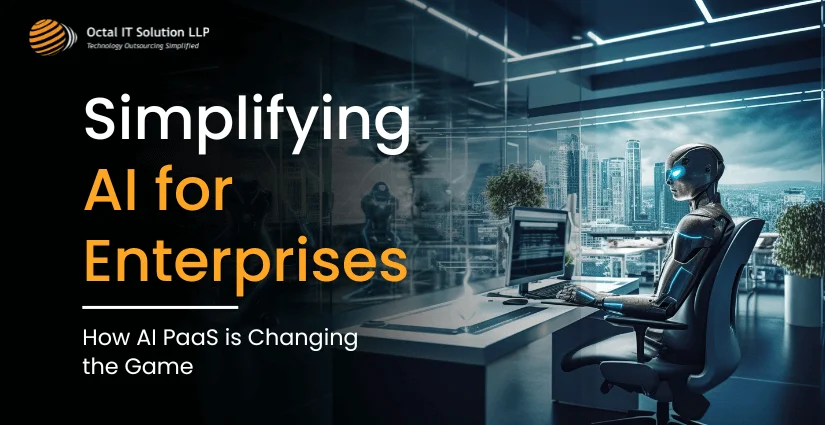
In the modern business world that is rapidly changing, companies are under pressure to implement artificial intelligence without building infrastructures or acquiring special knowledge.
Enterprise AI is a revolutionary solution, which, through Platform as a Service (PaaS), is a cloud-based option that is scalable and accelerates the deployment and streamlines workflows. By lowering the operational expenses and improving the use of data-driven decisions, AI PaaS systems enable organizations to be more innovative and remain agile.
Enterprises are able to integrate systems, consolidate data and automate processes easily by taking advantage of integration platform as a service capabilities. This blog discusses the characteristics, advantages, difficulties, and the latest tendencies of AI PaaS to help businesses adopt it fully in 2025.
Introduction
Have you ever wondered how big businesses can run on the power of advanced AI without having to construct intricate systems on the ground? Hire Octal IT Solution, a reliable AI development company that assists organizations to go through this transformation.
By 2025 the usage of artificial intelligence is not confined to technology giants with extensive assets Platform as a Service (PaaS) has opened AI to be accessible, scalable and easy to deploy. Think about the company that allows processing terabytes of customer information, forecasting the market trends, or automating your workflows without the need to employ a whole AI team.
This blog narrates the transformation of AI PaaS in revolutionising the working process of an enterprise, barriers are being broken and decision making is becoming quicker, smarter, and at a lower cost.
The Need for AI PaaS in Enterprises
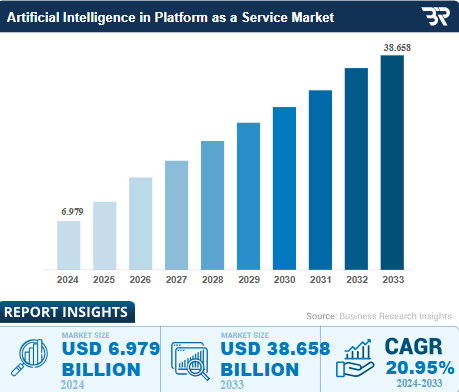
The global Artificial Intelligence in Platform as a Service (PaaS) market is valued at USD 6.97 billion in 2024 and projected to soar to USD 38.65 billion by 2033, registering a strong CAGR of 20.95% throughout the forecast period.
The implementation of AI has never been an easy task in big organizations. Expenses, infrastructure capacity, and lack of qualified AI experts are sluggish to projects. Numerous businesses cannot combine AI with the original systems or handle complicated processes.
PaaS platform solutions solve these problems by providing scalable cloud solutions with reduced overheads and an easy deployment process. PaaS enables companies to consolidate data sources, automate business operations, and ensure operational efficiency with ready-made models and integration platform as a service solutions.
Instead of being risky and costly, as with the traditional AI infrastructure, enterprises are now able to experiment, iterate, and innovate and adopt AI faster and more strategically.
Key Features of AI PaaS Platforms
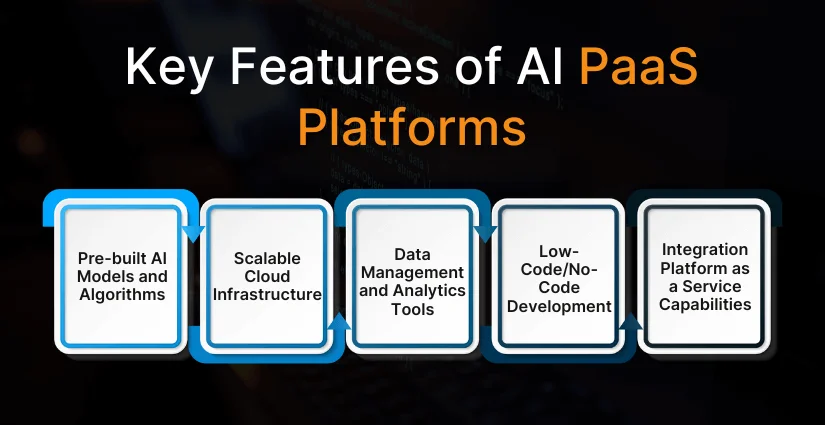
Agility, scalability, and automation are introduced by AI PaaS platforms to enterprises. They provide simplified adoption with ready to use models, cloud infrastructure and data tools. The development solutions of the top Artificial Intelligence Development Company will emphasize the rising significance of AI in the current market.
Pre-built AI Models and Algorithms
Ready-to-use AI models in predictive analytics, natural language processing, and computer vision can be utilized by enterprises to get insights faster and cut down on development time; and allow teams to focus on innovation instead of model creation, leading to quicker and more precise decision-making.
Scalable Cloud Infrastructure
AI PaaS services offer a limited capacity on-demand computing service that enables business enterprises to dynamically scale workloads. Companies are able to process large volumes of data, execute sophisticated AI applications with minimal resource usage, and adapt to evolving business needs and operations without expensive physical infrastructure.
Data Management and Analytics Tools
The tools can also work well with the existing enterprise systems and can facilitate automated data ingestion, cleaning, standardization and advanced analytics. The enterprises will be capable of deriving actionable insights in a short period and enhance the accuracy and make smarter decisions across departments without compromising the data consistency and reliability.
Low-Code/No-Code Development
Both developers and business users are able to develop AI applications with low-code and no-code interfaces without having to possess extensive knowledge in programming. This makes AI more democratic, speeds up application development,
Integration Platform as a Service Capabilities
Integration PaaS links up a variety of enterprise applications and databases and automates the workflows, allowing single AI operations. It will guarantee smooth data flow, less manual work, efficiency, and enable enterprises to effectively utilize AI in a variety of systems and departments.

What is Platform as a Service and How It Works?
Knowing what is platform as a service will enable businesses to simplify the adoption of AI using cloud-based solutions. It eases the process through infrastructure management up to integration. SaaS Development Services are also assessed by many companies as an addition to PaaS in order to achieve the maximum performance and scalability.
It encompasses data storage, computer processing, pre-trained AI models and development frameworks to play down AI implementation. Compared to the traditional AI system, which demands a large amount of IT investment, platform as a service PaaS helps teams to concentrate on innovation and not infrastructure.
PaaS guarantees quick deployment, programmed workflows and low-code interfaces through real-time analytics, a seamless integration and scalable AI solutions across enterprise ecosystems.
Benefits of AI PaaS for Enterprises
AI PaaS improves the productivity of the enterprise, being faster to deploy, cheaper, and simpler to expand. It also democratizes AI to all departments as in SaaS: How it’s Transforming the Industry, to allow smarter workflows and innovation across organizations.
| Benefit Name | Impact Description |
| Faster AI Implementation | PaaS can be deployed by businesses quickly, with minimal IT investment, accelerating time-to-value and enabling organizations to respond more quickly to demands. |
| Reduced Infrastructure Costs | Cloud-based PaaS does not require costly servers, maintenance or on-premise AI team, reducing the overall cost of operation. |
| Scalable and Flexible Solutions | AI PaaS can be scaled by organizations dynamically to meet demand without incurring additional IT expenditure. |
| Democratization of AI | Low-code interfaces and pre-built models allow non-experts to leverage AI, empowering business units to innovate independently. |
| Enhanced Data Security | PaaS providers offer enterprise-grade encryption, access control, and compliance features, safeguarding sensitive enterprise data. |
| Continuous Model Updates | PaaS systems are continuously updated with state-of-the-art AI models, providing business leaders with an opportunity to use AI in real-time and nearer to business operations.. |
| Improved Decision-Making | High-level analytics and predictive models are used to develop business decisions that are informed and based on data rather than manually maintained. |
AI PaaS vs Traditional AI Deployment
AI PaaS help decrease the expenses of infrastructure and speed up AI adoption in comparison to conventional implementation. Ready-to-use models and scalability of the cloud provide quicker ROI. These are some of the alternatives that enterprises consider when choosing among Custom vs SaaS-Based Platforms in an attempt to settle on the best strategy of innovation.
| Aspect | Traditional AI Deployment | AI PaaS (Platform as a Service PaaS) |
Infrastructure | Enterprises manage hardware, software, and servers in-house, costing $500K–$1M+ annually for servers, storage, and maintenance. | Cloud infrastructure is managed by the provider, costing $50K–$200K/year, reducing upfront capital expenses and scaling on demand. |
| Model Development | Custom AI model development requires in-house data scientists, costing $150K–$300K per model, with long development cycles. | Pre-built AI models included in PaaS accelerate deployment, reducing model-specific costs to $20K $50K/year. |
| Integration | Integrating with legacy systems requires specialized IT staff, adding $50K–$150K annually in labor and tools. | PaaS platforms provide integration platform as a service features, lowering integration costs to $10K–$40K/year. |
| Cost & ROI | Total implementation: $700K–$1.5M+, ROI slow due to complexity and time needed for deployment. | Total PaaS cost: $100K–$300K/year, faster ROI due to rapid deployment and lower infrastructure expenses. |
| Collaboration & Accessibility | Limited to specialized AI teams; cross-department collaboration is minimal. | Democratizes AI, allowing multiple departments to access AI insights at minimal extra cost. |
| Maintenance | Manual updates require $50K–$100K/year for support and patches. | Continuous updates and maintenance handled by provider, included in subscription cost. |
Top Industries Leveraging AI PaaS in 2025
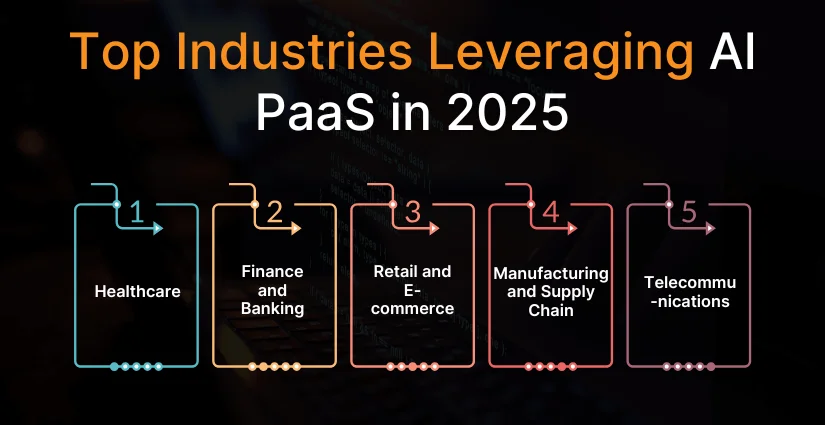
Increasing industries such as healthcare, finance and manufacturing are opening up to AI PaaS. It simplifies operations, minimizes risks and increases efficiency, reflecting the changes that the Best SaaS Development Companies in 2025 bring, which equips businesses with solutions that enable them to stay afloat.
- Healthcare
AI PaaS simplifies the process of diagnostics, predictive modeling, and patient data management. It helps to identify diseases more quickly, create a tailored treatment regimen, and monitor health status in real-time, enhancing clinical performance and minimizing mistakes, bureaucracy, and expenses of healthcare organizations.
- Finance and Banking
Fraud detection, credit risk analysis and customized financial services are powered by AI PaaS. Its ability to analyse large volumes of data in real time helps financial institutions to address anomalies in their operations, predict the market and automate compliance and thus improve security, efficiency and customer satisfaction.
- Retail and E-commerce
AI PaaS streamlines the inventory control, predicts customer behavior and customizes the shopping experience. It assists the retailers in forecasting demand, minimizing stockouts, promoting, and enhancing customer interaction, and eventually, sales expansion and operational efficiency in competitive markets.
- Manufacturing and Supply Chain
AI PaaS enhances predictive maintenance, quality control and process automation. It minimizes downtime by using equipment performance and production data to improve product consistency, streamline workflows and assist in making smarter decisions across the supply chain.
- Telecommunications
AI PaaS increases the performance of the network and predictive maintenance, as well as customer service. It prevents traffic spikes, predicts failures in the system, and automates responses to services and lets telecom providers to make the most out of their infrastructure, minimize their operational costs, and offer better user experiences.
How AI PaaS Simplifies Enterprise AI Adoption?
Collaboration functionality also has the benefit of sharing AI insights with various departments, which will accelerate innovation and benefit decision-making. The application of AI can be considered a strategic advantage and not a challenge of technology in enterprise deployment, due to lower prices, ease of maintenance, and constant update of models.
Platform as a service PaaS enables enterprises to use AI more effectively and efficiently by eliminating barriers to infrastructure and expertise. Teams can easily integrate PaaS with the existing systems and use ready-built models and even scale business without IT bottlenecks.
Challenges and Limitations of AI PaaS
Even though there are benefits, AI PaaS is associated with obstacles such as lock-in with vendors, integration, and compliance problems. Breaking such a feat takes planning and support, which are similar to practices that have been emphasized in AI on Project Management: Tools and Best Practices to assist the enterprises reduce risks.
Data Privacy and Compliance
The use of AI PaaS in enterprises should meet the requirements of strict regulatory documents like GDPR or HIPAA. Financial or customer information as sensitive data should be encrypted and stored safely and under control to avoid any breach and ensure trust.
Integration Complexities
It is difficult to connect AI PaaS and old systems. The variation in data format, APIs, and workflow can lead to delays or errors, which need to be planned, middleware, or integration platform as a service functionality to ensure that all processes are interoperable.
Vendor Lock-in
Flexibility can be limited by using one AI PaaS provider. Changing providers can be expensive or technologically difficult or it can be a challenge in getting the data migrated, meaning that new capabilities may not be available to the organization or strategic IT choices may be restricted going forward.
Limited Customization
Pre-built AI models may not fully align with specific enterprise requirements. Organizations may need to modify workflows, retrain models, or integrate additional tools to achieve desired results, increasing complexity despite the convenience of ready-to-use PaaS solutions.
Future Trends: The Evolution of AI PaaS Beyond 2025
AI PaaS has a future in IoT integration, digital twins, sustainability. These patterns will restructure the automation of enterprises similar to what Best SaaS Development Companies in 2025 revealed, demonstrating innovation that defines smarter businesses all over the world.
| Trend Name | Future Impact |
| Integration with Edge Computing | Connected systems automate workflows, track operations, and improve predictive maintenance. |
| AI + IoT Platforms | Fully connected systems automate workflows, monitor operations, and enhance predictive maintenance. |
| Generative AI as a Service | AI produces models, insights, or even content automatically, speeding up the innovation cycles. |
| Automated AI Model Creation | Simplifies training and deployment of custom models without specialized expertise. |
| Global Accessibility and Democratization | Saves businesses in any part of the world to accept AI cheaply and efficiently due to cloud-based PaaS. |
Why Octal IT Solution Can be the Best Choice For You?
The collaboration with the Octal IT Solution will provide a smooth development and deployment of AI PaaS solutions that will be optimized according to your enterprise needs. They have a profound knowledge of AI and cloud technologies that enable business to deploy scalable, secure, and efficient AI platforms without a heavy investment in infrastructure.
Octal IT Solution is a provider of custom software development services, end-to-end AI development services, and integration, so that your workflows are integrated and automated. Having a well-established experience in the industry in the fields of healthcare, finance, retail, and manufacturing, they offer future-proof and scalable solutions that facilitate innovation and ROI.
The decision to select our team is providing quicker adoption of AI, less complexity, and the ability to have access to the latest technology to gain competitive advantage over time.

Conclusion
AI PaaS is revolutionizing business processes by eliminating the conventional obstacles to the use of AI. Enterprises can gain access to scalable infrastructure, pre-made models, and integration options in order to accelerate innovation, streamline operations, and make decisions based on the data at a faster rate.
Through Platform as a Service, enterprises save money, increase security and allow interdepartmental teams to embrace AI without any hustle. With the appearance of such trends as AI + IoT and generative AI, PaaS services will grow in importance as a competitive advantage.
To become agile, efficient, and future-ready via AI, Platform as a Service turns into an obligatory, yet also strategic choice among the enterprises.


 Get in Touch
 By
By September 30, 2026